



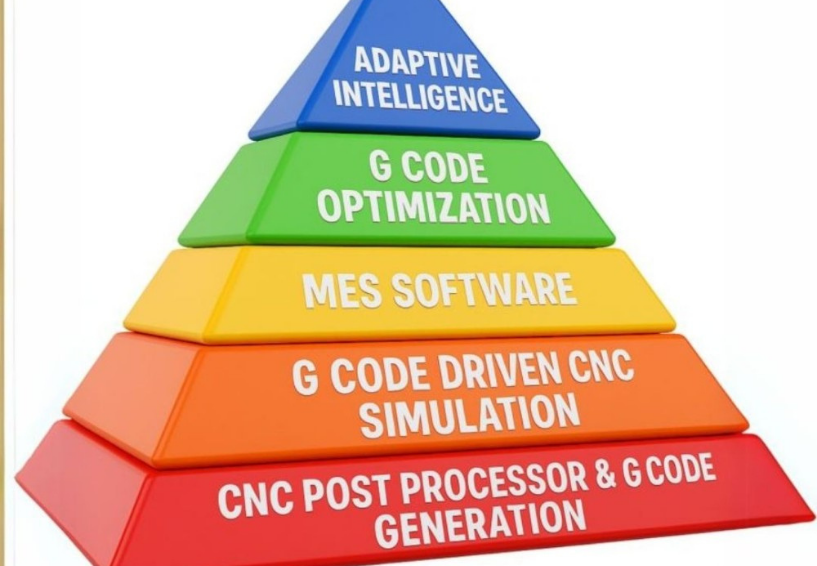
In manufacturing, there’s a tendency to rush toward the latest trends — real-time analytics, adaptive machining, AI-driven strategies — often without laying the groundwork for success. But just like humans have basic needs that must be met before they can reach their full potential, CNC machines follow a similar hierarchy.
Think of it as the CNC Machine Needs Pyramid — a framework that helps us understand what truly enables performance, reliability, and adaptability on the shop floor.
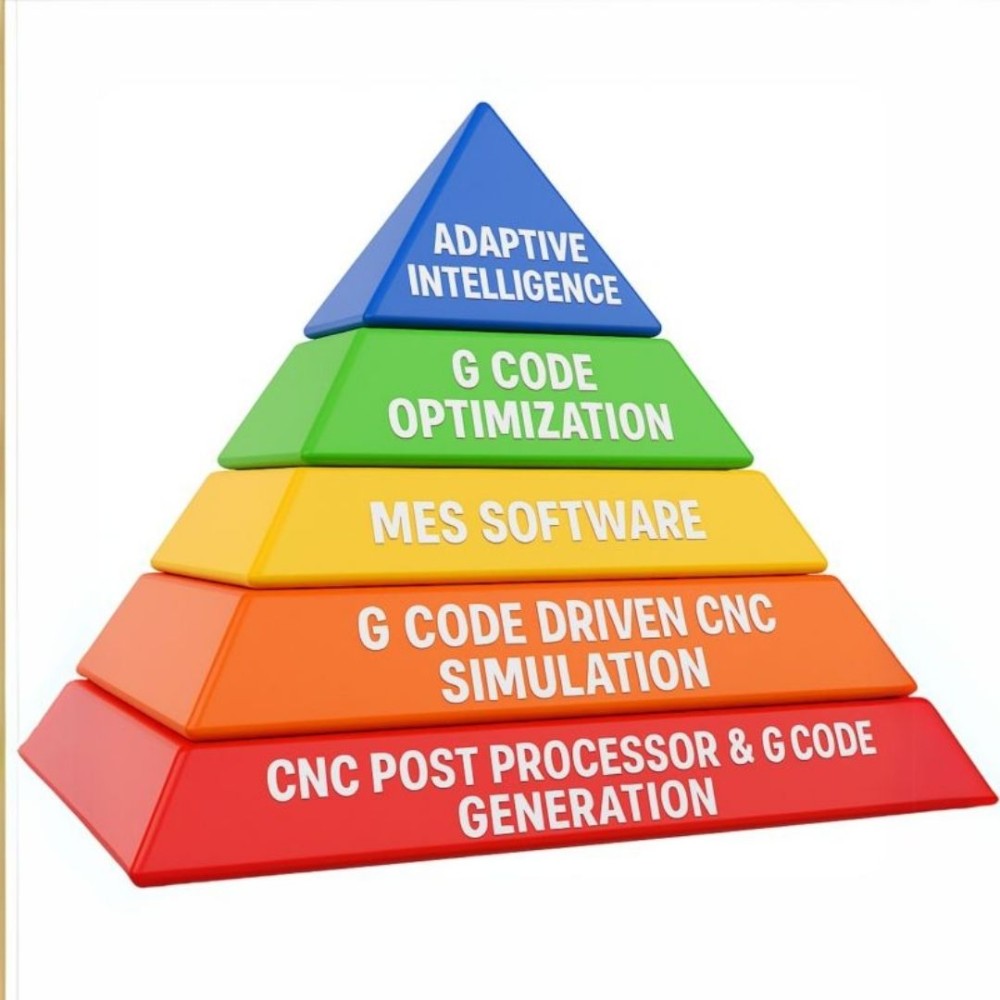
🟥 1. Physiological Needs → Post Processors & G-code Generation
This is the foundation. Without valid, executable G-code, a CNC machine can’t function — no matter how powerful the CAM software is. You can design perfectly in CAD/CAM, but if the CNC post processor isn’t aligned with the actual machine requirements, everything downstream is compromised.
🟧 2. Safety & Security → G-code Driven CNC Simulation
Next, you need confidence that the CNC machine will behave as expected. Simulation must be based on actual NC code, not just CAM toolpath animations. Real simulation identifies collisions, limit over-travels, feedrate errors, and other issues before they lead to downtime or damage. This is predictive safety — not just visual reassurance.
🟨 3. Love & Belonging → MES Integration
Once you have control and confidence, your CNC machine should become part of the larger system. Manufacturing Execution Systems (MES) connect machines to planning, traceability, scheduling, and ERP tools. This gives structure, transparency, and visibility to the production environment.
(Interestingly, some would place G-code optimization here — and rightly so. Even without a full digital ecosystem, a single CNC can start delivering better results through optimization.)
🟩 4. Self-Esteem → G-code Optimization
This is where your machines start performing at their best. Eliminating air cuts, reducing non-cutting time, increasing feedrates where possible — optimized G-code leads to faster cycles, less energy waste, and more intelligent toolpaths. At this stage, your machine isn’t just doing the job — it’s doing it well.
🔵 5. Self-Actualization → Adaptive Intelligence
At the top of the pyramid sits adaptive machining and closed-loop intelligence. This is where machines respond to feedback, learn from conditions, and optimize themselves in real time — evolving from tools into smart production assets.
Are You Building Your Pyramid in the Right Order?
Many shops skip steps — implementing MES or exploring AI before even simulating their code. It’s like planning a housewarming party before the concrete’s been poured.
The path to intelligent manufacturing starts with mastering the fundamentals. Post processing, real NC simulation, and G-code optimization aren’t just helpful — they’re essential.
Let’s hear your thoughts: Where is your shop on the CNC Needs Pyramid? What’s the next step in your journey?